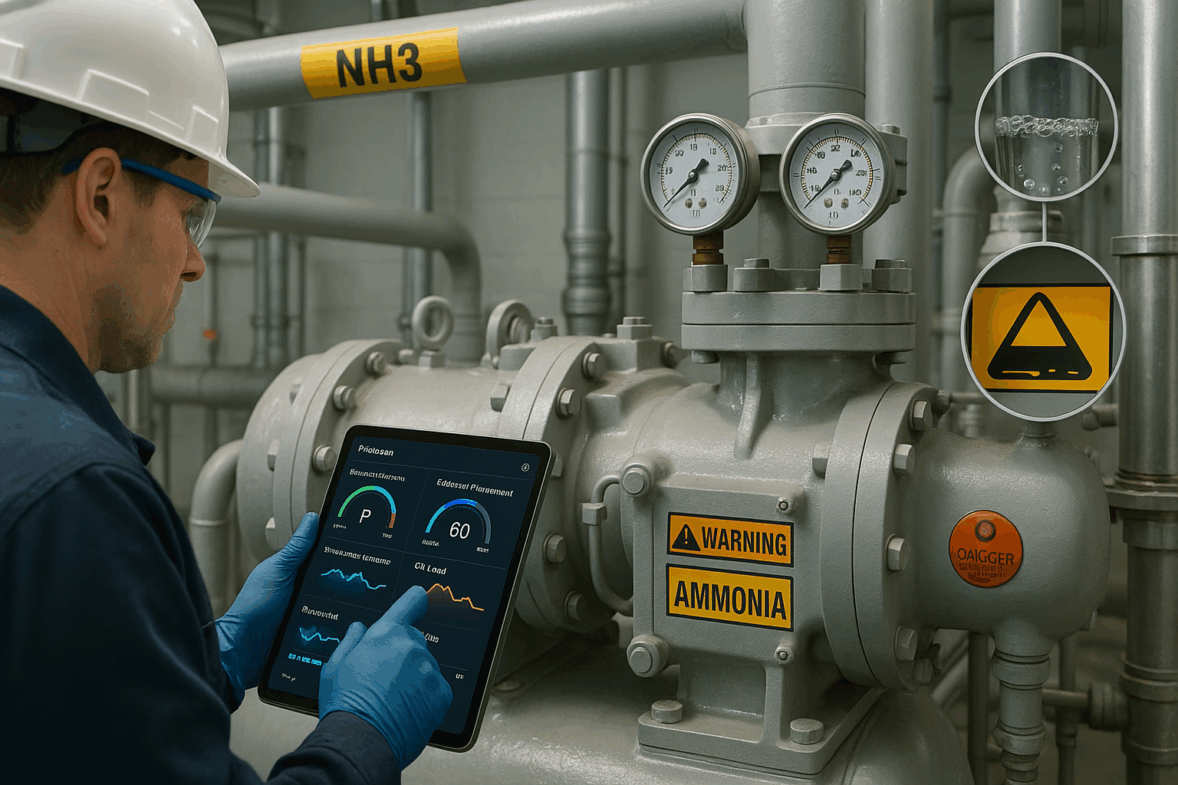
Does your industrial refrigeration unit give you trouble? Ammonia is an effective and economical refrigerant in the realm of commercial and industrial HVAC, but high temperatures and a very high-pressure environment may require a close charge to work properly. The wrong charge of ammonia is not something like a piece of cake: it may result in some huge expenses on the energy bills as well as request not only a complex repair of the damaged system but also cause some security risks.
It is an important skill as a business owner or an experienced HVAC professional to understand how to find an improper charge quickly. The following guide will divide the most frequent red flags that one may encounter and what each of the symptoms could tell him/her about the ammonia levels in the system.
Why Is a Correct Ammonia Charge So Important?
So what is so important about a perfect ammonia charge before we get into the red flags?
- Safety: Ammonia is indeed a hazardous chemical. Any system that becomes overcharged may become too highly pressurized and can result in leakage or the equipment breaking catastrophically.
- Efficiency: Optimum heat is transferred and the evaporator operates efficiently due to the right charge that consumes less energy, and thus operating costs are minimized.
- Performance: A system that is undercharged may not cope with cooling requirements, therefore making the temperatures and level of spoilage of products in the cold rooms high.
- Longevity: When the systems are properly charged, they work within their design capabilities minimizing the loads on compressors and other parts, extending the life of your equipment.
More than just the obvious performance and safety factors, there exist a number of good reasons to make sure your ammonia charge is right:
- Regulatory Compliance: The usage and handling of ammonia is regulated in the United States by the Occupational Safety and Health Administration (OSHA) and the Environmental Protection Agency (EPA) regulations. Processing Safety Management (PSM) standard by OSHA involving Ammonia refrigeration plants demands a comprehensive knowledge and record of the charge of your system.
- Energy Efficiency: In a badly charged system a lot of energy can be lost. A system that is undercharged causes the compressor to work harder and a system that is overcharged, can lead to the compressor becoming inefficient with liquid ammonia entering the compressor, which may result in broken compressor.
- Longevity of your System: Preserving the right charge will ensure there is no unnecessary wear and tear of your system. This saves on repair and increases the life of your compressors, heat exchangers among other important parts.
- Environmental Responsibility: A harmful release of ammonia is still dangerous although the global warming potential (GWP) of ammonia is lower than that of the other fluids and it has a zero ozone depletion potential (ODP). Well charged and maintained system lessens the possibility of leakages endangering not only your employees but also the environment.
Neither scenario is good for your bottom line or the longevity of your equipment.
Factors That Influence the Correct Ammonia Charge
The amount of ammonia that is considered right is not a number which fits all. It is an exact estimation and based on a number of important factors:
- System Size and Design: The overall-filled volume of the piping, vessels (like the receiver and the separator) and the evaporators determines the base charge. More volume of the refrigerant is needed in a larger system.
- Operating Temperature and Pressure: The wanted cooling temperature directly touches upon the portion of the ammonia required. A system that will work at lower temperatures as compared to another operating at higher temperatures will experience different charge requirements.
- Ambient Conditions: The outside temperature and Moisture have an impact on the condensing pressure and thus the ideal charge.
- Type of System Components: The models and sizes of your compressor, condensers and even your evaporators should all influence just how much charge is optimal.
Failure to pay attention to these factors may result in an inaccurately calculated charge, and put your system up to fail in the first place.
Dangers of under- and over- Charging
Efficiency is not the only point to consider; it is safety and the preservation of investment.
Risks of Undercharged System:
- Compressor Overheating and Failure: Excessive loads are handled by the compressor continuing to run and continuing to overheat without the cooling effect of the refrigerant. With this too much friction and heat, it may burn out the motor and the cost of replacing it entirely is quite high.
- Issues in the Cooling Capacity: The easiest and the first risk that can happen. It is that your system will just not cool as efficiently and this may jeopardize the integrity of products stored within a refrigerated environment.
- Higher Energy Bills: Running of the compressor and when it runs longer it is compensating the shortage of the refrigerant which means directly increases the electric bills.
- Oil Circulation Issues: It is possible that low flow of refrigerant causes the oil to sit in the evaporators, depriving the compressor of needed lubrication.
Risks of an Overcharged System:
- Liquid Flood back: This is the risk which might be most hazardous. Surplus liquid refrigerant may be drawn back into the suction line of the compressor. Liquids are not compressible and this may result in serious harm to the internal parts of the compressor like bent connecting rods or shattered valves.
- Too Much Pressure High Head Pressure: Overcharge produces too high pressure in the condenser and the compressor must work against far too high resistance. This may result in the high-pressure safety cut out changes, bringing about the system to go off many times.
- Poor Heat Transfer: An overcharged system causes flooding of the condenser where the liquid refrigerant will take up the available space diminishing the amount of surfaces that will be available to transfer the heat within the system.
- Safety Release Actuation: In the high overcharge conditions, the pressure may reach the level that the safety relief valves or the rupture discs may open up dumping the ammonia to the surrounding area.
Red Flag #1: Abnormal Suction Pressure Readings
This is normally the initial and the most credible sign of an ammonia charge problem. The pressure of the ammonia vapor coming into the compressor will be that of your suction pressure.
- If the Suction Pressure is Low: This is typical indicator of an under charged system. When the amount of the ammonia in the system is low, there is no sufficient refrigerant passing through the evaporator in order to provide the appropriate pressure. The compressor will struggle to create a vacuum and the cooling will be diminished and energy consumption will increase.
- If the Suction Pressure is High: High suction pressure is common with overcharged system. The superfluous refrigerant does not have an opportunity to evaporate properly, which makes the liquid to reappear in the suction line of the compressor. Not only does this exert pressure but it also brings with it a great danger of liquid flood back that is capable of ruining the compressor.
The Fix: Try your pressure gauges and refer to design specification of the system. When your suction pressure is abnormally higher or lower than normal operating pressure routinely, then it is time to inquire into the level of charge.
Red Flag #2: Fluctuating or High Discharge Temperature
The temperature of the leaving the compressor superheated ammonia vapor is the discharge temperature. It is a pure indication of the effort your compressor is driving.
- High Discharge Temperature: This is one of the major symptoms of undercharged system. Once there is not much refrigerant in the system, the compressor has to over-work and compress the available little vapor. All this friction produces too much heat with the discharge temperature reaching high levels. Compressor inefficiency and poor health is the major red flag.
- Low Discharge Temperature: Less likely to be a direct symptom, unless liquid refrigerant is flooding the compressor there will be a lower than normal discharge temperature with an over charged system. Liquid is likely to lead to the compressor to run cool, which is a hazardous symptom itself, that shows that the floodback is serious.
The Fix: Check your suction pressure and also your discharge temperature. When you notice high temperatures with a low suction pressure you can be very sure you have undercharge.
Red Flag #3: Unstable Oil Level in the Oil Separator
The compressor requires oil for lubrication in the ammonia refrigeration system. The role of oil separator is to extract this oil contained in the refrigerant vapor and send it back to the compressor.
- Undercharged System: An undercharged system has low velocity of the refrigerant moving via the evaporator. This may result to oil getting trapped in the evaporator, hence resulting to the almost constant low oil level in the separator. The compressor without enough lubrication is in danger of premature breakdown.
- Overcharged System: An abundance of the refrigerant may also wash the oil out of the compressor and bring it along with the liquid creating unstable low oil levels. In a similar fashion, either elevated oil level or low oil level indicates that the balance has been lost in the system.
The Fix: Regularly check the oil separator’s sight glass. When the oil level is regularly either low or is unstable, it is a clear sign of ammonia charge issue.
Red Flag #4: Inconsistent or “Washed-Out” Sight Glass
The sight glass is a significant diagnostic instrument and usually it is found in liquid line. It will enable you to check visually on the condition of the refrigerant.
- Overcharged System: A fully liquid sight glass with no bubbles is a sign of an overcharged system. It has excess refrigerant in the system that is backing up in the liquid line..
- Undercharged System: A “flashing” or bubbly sight glass can indicate an undercharged system. This flashing takes place because of a pressure reduction leading to boiling of the liquid refrigerant prior to arrival in the expansion value. When there is a constant flow of bubbles, this means that the refrigerant is seriously lacking.
The Fix: A clear, full liquid line is the goal. Excessive bubbles or sight glass that is totally clear is an indication to carefully check the entire system.
Red Flag #5: The Compressor is Short-Cycling
Short-cycling refers to the compressor turning on and off very quickly so that a full cooling process was never really carried out.
- Undercharged System: With a low charge, there will be a problem in keeping up with the cooling demand. The safety switch with a low-pressure can be activated and stop the compressor before its end. It next fails to reach the setpoint, increasing the pressure a bit and the process again repeats. Such on-again off-again cycling is very harmful to the motor of the compressor.
- Overcharged System: The overcharged system may also short-cycle as a result of high-pressures associated with trips of safety switches. High pressures due to the excess refrigerant also lead to the high discharge pressures and the high-pressure cutout switches the equipment off to avoid damages.
The Fix: In case you observe that you are seeing your compressor start and stop after short periods, then you should not be oblivious to it. It is an audible and unmistakable signal that something is deeply amiss and it is usually something to do with an unwarranted charge.
Saving money on the wrong ammonia charge, which can cost you efficiency of your system and its security, is not a good idea. Bring your team in the loop concerning how to monitor diagnostics and maintenance.